THANK YOU FOR SUBSCRIBING

The Quintessential Technology Source for Corporate Financial Professionals


CFO Tech Outlook Weekly Brief
Be first to read the latest tech news, Industry Leader's Insights, and CIO interviews of medium and large enterprises exclusively from CFO Tech Outlook
For more than 30 years, CPRS has worked in a corner of finance that most people rarely think about but every large organization depends on: Accounts Payable Recovery Audits. These audits sit at the intersection of accounting, operations, vendor management and data integrity. When they are done well, AP Recovery Audits reveal hidden inconsistencies, expose systemic gaps, return lost dollars to the balance sheet, and sharpen the internal controls that keep organizations financially healthy. “In an industry once built around slow, retrospective reviews, we have helped push recovery audits toward something more forward-looking and continuous,” says Dan Berg, President. “Beyond our decades of experience, CPRS stands out for how we have influenced and elevated the very nature of the work.” CPRS’s approach rests on three principles—experience, expertise, and technology. The interplay among them has driven much of the innovation that clients expect from a modern audit partner. Previously, recovery audits were treated as damage control. Organizations waited a year or two, handed over files, and hoped the auditors would find enough value to justify the exercise. CPRS saw early that this model was not designed for a world where transaction volumes were rising and financial systems were growing more complex. Errors were happening closer to the transaction date, and waiting months or years to inspect the data meant organizations were responding too late.
Wishing for Wealth should always be paired with the boon to preserve it—because if the former is granted, the latter becomes a necessity. A windfall of wealth, no matter how large, can easily be squandered if not handled well. With considerations like investment, financial, taxation and estate planning, trusted financial advisors must be roped in as fiduciaries for the newfound wealth. However, the ever-expanding scope of their service demands a more holistic wealth management approach, which is realistically possible through Wealth Inc. A renowned name in the world of fintech, the firm enables financial advisors to provide greater number of services at scale efficiently and economically through its wealth planning platform, Wealth.com. Specializing in estate planning, it empowers financial advisors and entities by modernizing the delivery of estate planning guidance to their clients. Wealth.com is the only tech-led, end-to-end estate planning platform built specifically for financial institutions and advisors. “Our platform uses technology to drive efficiency and repeatability without compromising quality or the bespoke nature of the financial advisory work,” says Danny Lohrfink, co-founder and CPO. Wealth.com stands out from the market in delivering a truly scalable experience for financial advisors. This focus on scalability is ingrained in the platform by its creators, including a CEO with a CTO background. They ensured that unlike traditional point solutions that operate in silos, Wealth.com is designed with integration and scale in mind. This design philosophy eliminates the inefficiencies of fragmented tech stacks—common when managing multiple platforms that don’t communicate with one another. Wealth.com avoids this pitfall by directly embedding an advisor’s existing systems through API integrations. When an advisor logs in for the first time, the dashboard is already populated with their entire business book. Eliminating inefficiencies and giving advisors a comprehensive, real-time view of their clients without lifting a finger. This frictionless onboarding process is a game-changer, positioning Wealth.com as a tech-forward, advisor-first platform built for the modern-day finance professionals. They can use the platform to serve clients across the net worth spectrum. Wealth.com offers a scalable solution that adapts to each client’s unique needs. Whether helping a mass affluent client draft their first will, evaluate the impact of relocation on inheritance and tax liability, or assist an ultra-high net worth client visualize an estate with Spousal Lifetime Access Trusts (SLATs), Grantor Retained Annuity Trusts (GRATs) and Irrevocable Life Insurance Trusts (ILITs).

The financial world has never lacked innovation, but it often lacks stability. For years, institutions have faced a dilemma: adopt digital currency models built for speed and scale or stick with conventional systems that offer trust but slower progress. Few have successfully combined both. As inflation rises, regulations tighten, and banking systems face unpredictable disruptions, the need for a reliable, transparent, and asset-backed digital framework has never been greater. That is where EIG Global Trust enters the picture. The company has developed a fully gold-backed digital currency framework designed specifically for central banks, commercial banks, and sovereign financial systems. It allows institutions to modernize their financial architecture without exposing themselves to volatility or regulatory uncertainty. “We’re not just creating digital money,” says Chris Paget, president. “We’re building a foundation of trust, something our clients can rely on without changing the rules of finance.” EIG Global Trust was founded by a team of six seasoned professionals, including auditors, regulators, and financial executives. Its leadership brings decades of experience working directly with governments, regulatory bodies, and global asset managers to create a system grounded in transparency and long-term value. From Proof of Value to Proof of Trust EIG Global Trust offers two principal digital currencies. The EIG Bank Coin is a one-million-dollar stable coin, large-scale bank collateral, backed entirely by physical gold and independently audited for compliance with the world’s top banking regulators and central banks. The second, USDGOLD, is once again entirely backed by physical gold pegged at $1,000 and used for operational settlements and establishing bank liquidity. Both digital currencies follow strict accounting standards established by the American Institute of Certified Public Accountants (AICPA) and are accounted for as USD cash under GAAP. Recently, the United Nations Bank for International Settlements has ruled that gold is no longer a Tier 3 asset. Instead, it is a Tier 1 cash equivalent pegged to the market price in USD. The implications are enormous as EIG Global Trust is leading the world’s fintech economy back to a USD reserve currency Gold Standard, unlike over 50 years of fiat currencies.

Frida Roneus, Head of Digital Strategy & Transformation, Sumitomo Mitsui Banking Corporation – SMBC Group

Paul Young, Chief Financial Officer, Liberty Bank − CT

Douglas Maxwell, Chief Financial Officer, American First Finance

Richard Kung, Chief Financial Officer, CTBC Bank Corp. (USA)

Ann Downey, Vice President of Accounting, North American Bancard

Linda Wilson, Senior Growth Account Executive, Transact Campus Inc

Brett Scyrkels, SVP, Director, Software Quality Engineering, BOK Financial
Accounts Payable recovery audit services are gaining momentum as businesses seek to uncover overpayments, improve compliance, and leverage technology for greater financial accuracy and efficiency.
Effective solutions to common accounting challenges help businesses improve financial accuracy, compliance, and decision-making for long-term growth.
Precision, Oversight, and the New Mandate for Finance Leaders
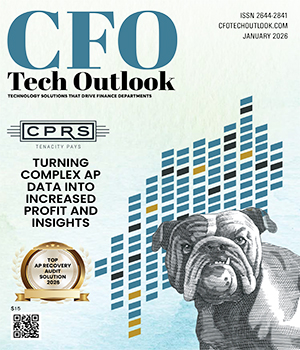
The cover story examines CPRS, recognized as the Top Accounts Payable Recovery Audit Solution 2025, and its role in reshaping a function long treated as financial afterthought. For more than three decades, the firm has operated at the intersection of accounting, operations, vendor management, and data integrity, identifying errors that persist even in sophisticated AP environments.
CPRS has helped move recovery audits away from slow, retrospective exercises toward a more continuous and preventative discipline. By combining deeply trained, industry-specific audit teams with its proprietary Pearl™ machine-learning platform, the company enables faster analysis, lower spend thresholds, and earlier detection of systemic issues. The result is not only recovered dollars, but stronger controls, clearer operational insight, and fewer errors entering the system in the first place.
Risk management features prominently across this issue. Jacqueline Breslauer, Executive Vice President and Chief Audit Executive at Valley Bank, argues that internal audit functions have moved beyond assurance into strategic partnership. As reputational, liquidity, and technology risks intensify, audit teams are expected to collaborate more closely with business leaders, aligning control frameworks with organizational objectives. Adaptive audit models, she notes, are no longer optional but essential.
Growth, meanwhile, remains a parallel priority. Jack M. Jacobs, Senior Vice President of Commercial Banking at WesBanco Bank, Inc., describes how customized banking solutions and relationship-led strategies are helping banks compete for middle-market clients. As these companies become more sophisticated, banking relationships are judged less on products and more on insight, trust, and long-term alignment.
Together, the stories in this issue underscore a central truth: sustainable financial leadership is built on precision, partnership, and foresight. We invite readers to explore these perspectives and engage with the strategies shaping the future of financial management.